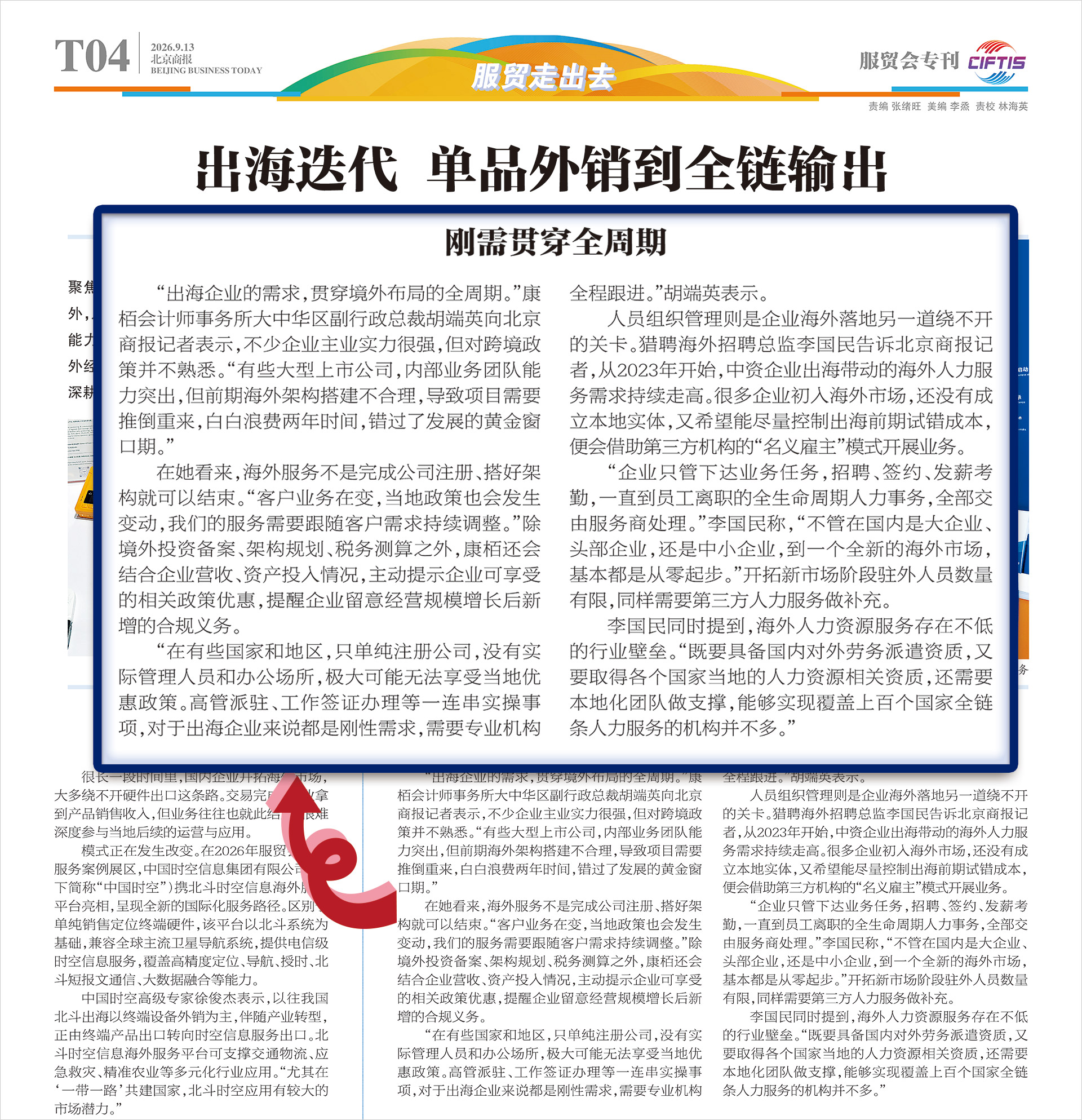
Conpak Shares Insights on Full-Cycle Professional Services for Enterprises Going Global in Interview with Beijing Business Today
As Chinese enterprises accelerate their global expansion, the focus of "going global" has evolved beyond product exports to encompass cross-border tax and financial planning, corporate structuring and local market operations. Recently, Conpak was interviewed by Beijing Business Today, sharing insights into the common challenges encountered by enterprises in cross-border operations, together with practical approaches to addressing them.
Early-Stage Planning: Avoiding Disconnects Between Corporate Structure and Business Objectives
In the early stages of global expansion, enterprises often focus primarily on target markets, business opportunities and operating models, while underestimating the impact of outbound investment approvals, cross-border corporate structuring and tax planning on their future operations.
In the interview, Ms Hu Duanying, Deputy Chief Executive Officer of Conpak Greater China, commented: "Many enterprises possess strong business capabilities but have limited familiarity with cross-border regulations and compliance requirements in their target markets. As a result, the importance of corporate structuring is often overlooked during the early stages of overseas expansion."
Therefore, when planning overseas expansion, enterprises must factor in investment pathways, operational arrangements and regulatory requirements in their target markets, while conducting a comprehensive assessment of Outbound Direct Investment (ODI) requirements, cross-border corporate structuring and tax arrangements. Clarifying business needs and compliance requirements at an early stage helps enterprises reduce future restructuring costs and establish a more solid foundation for overseas business development.
From Company Incorporation to Actual Operations: Prioritising Local Compliance Requirements
The establishment of an overseas entity is only the starting point of an enterprise's global expansion journey. During day-to-day operations, enterprises must also pay close attention to local requirements relating to economic substance, staffing arrangements, tax residency status and reporting obligations.
In jurisdictions where economic substance requirements are clearly defined, enterprises should evaluate whether their overseas business activities, workforce and office arrangements align with their actual operations, while taking into account the associated tax implications. During the interview, drawing from real-world business scenarios, Ms Hu shared insights into aligning early-stage corporate structuring with local operational requirements to help enterprises identify potential risks and strengthen their compliance framework.
The interview with Beijing Business Today not only highlighted common challenges and solutions for enterprises expanding abroad, but also served as a practical reference for enterprises looking to venture into overseas markets. Moving forward, Conpak will continue to leverage its expertise in cross-border tax and corporate services to provide professional support for enterprises' overseas expansion and long-term operations, helping Chinese enterprises achieve sustainable international growth.